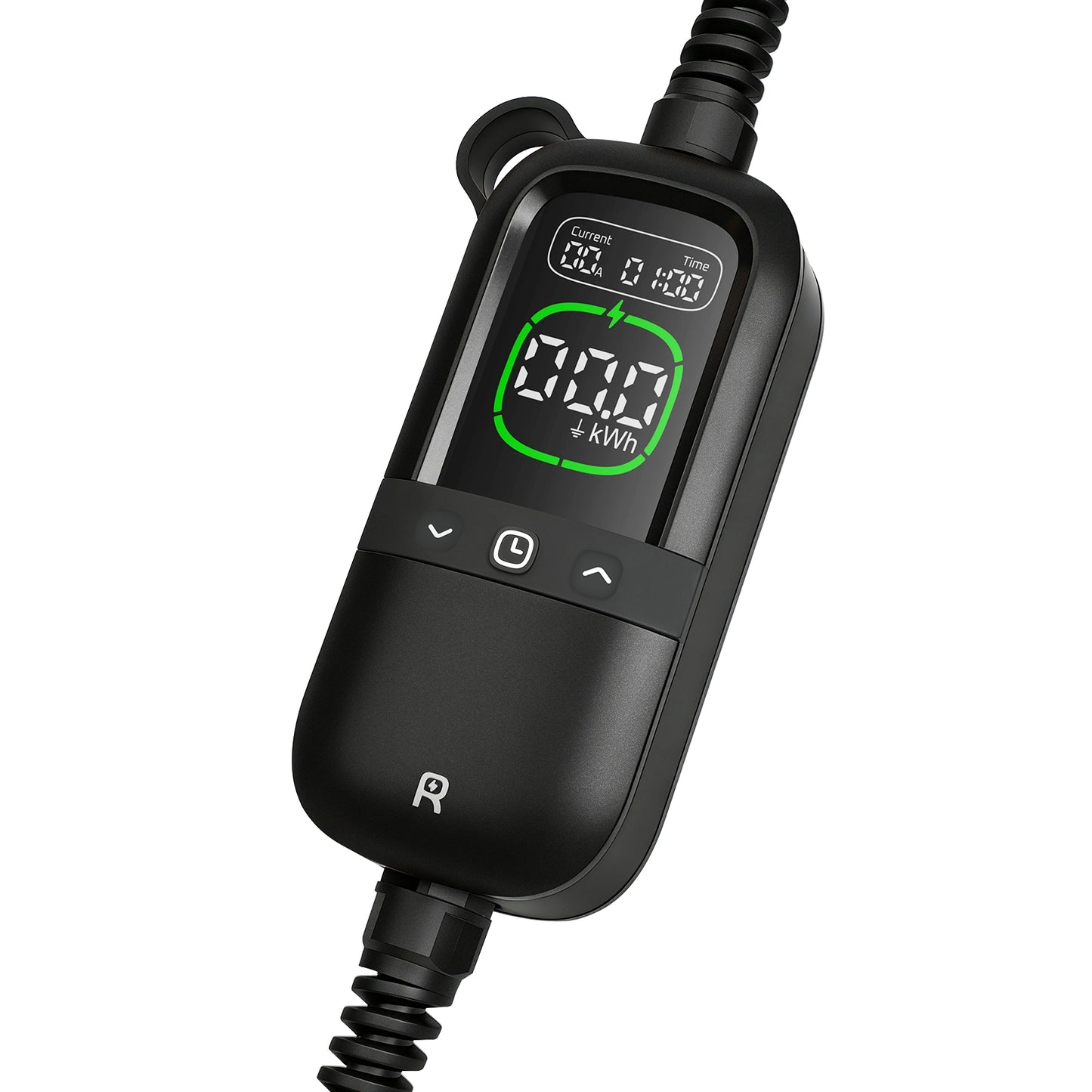
PC200 Pro-11K SPECIFICATION
Charging Power (Max)
11kW
Input
380 - 400V / 6 - 16A
Power Plug
(Interchangeable adapter system)
- CEE 16A 5-pole 3-phase — included
- Schuko (Type E/F), 16A — sold separately
- Schuko (Type E/F), 8A — sold separately
- Type G (British), 13A — sold separately
- Type J (Swiss), 10A — sold separately
- Type L (Italian), 10A — sold separately
- CEE Blue 3-pin, 16A — sold separately
- Type 2 Plug, up to 16A — sold separately
Connector
Type 2
Warranty
2 Years
Cable Length
7.5m
Charger Control Method
On-device / Remote via APP
Charging Access Method
Plug & Charging / Wi-Fi Enabled APP
Wi-Fi Module
802.11b/g/n 2,4GHz / frequency band 2412-2472Mhz
Bluetooth Method
BLE 5.0, 2.4GHz, up to 10m range
Operating Temperature
-30°C to +50°C
Charger Size
200 x 90 x 67mm
Weight
5.8kg
Screen
3.5 inches
Cable Color
Black
Keying
Mechanical Button
Storage Temperature
-30°C to +60°C
Operating Humidity
5% to 95%
Altitude Limit
< 3000m
Housing
Strengthen PC
Waterproof
IP65
Residual Current Device
Type A + DC 6 mA With Protective Conductor Monitoring
Standard
EN IEC 62752:2024
EN IEC 61851
EN IEC 61000-6-1:2019
EN IEC 61000-6-3:2021
EN IEC 62196, RoHS
EN IEC 61851
EN IEC 61000-6-1:2019
EN IEC 61000-6-3:2021
EN IEC 62196, RoHS
Safety Protection
Leakage Protection
Grounding Protection
Over Current Protection
Anti-Thunder Protection
Over Temperature Protection
Plug Temperature Protection
Short Circuit Protection
Low Voltage Protection
High Voltage Protection
Grounding Protection
Over Current Protection
Anti-Thunder Protection
Over Temperature Protection
Plug Temperature Protection
Short Circuit Protection
Low Voltage Protection
High Voltage Protection
FAQs
What is the difference between the PC200 Pro-7K4 and the PC200 Pro-11K?
The 7K4 uses single-phase power (230V, up to 32A) and delivers up to 7.4 kW. The 11K uses three-phase power (400V, up to 16A) and delivers up to 11 kW, but is limited to 3.6 kW when connected to a single-phase socket.
If your home has a three-phase socket (common in Germany, Austria, Switzerland and much of Northern Europe), the 11K is the better choice.
Do I need an electrician to use the PC200 Pro-11K?
The PC200 Pro is designed to be plug-and-charge — no installation required.
However, we recommend having a qualified electrician verify that your existing socket and wiring are up to the task before first use, particularly for sustained high-current charging.
Can I use it at a public AC charging station or wallbox?
Yes, with the Type 2 Quick-Switch adapter (sold separately). It supports up to 11 kW on a three-phase connection and up to 3.7 kW on a single-phase connection.
Can I take it abroad and charge in other countries?
Yes. The Quick-Switch adapter range covers the major European socket types: Schuko (DE, FR, AT, NL and most of continental Europe), Type G (UK, Ireland), Type J (Switzerland), Type L (Italy) and CEE industrial sockets. Select the adapter for your destination.
Can I leave it plugged in all the time?
Yes. The charger only delivers power during an active session and monitors itself continuously. It is designed for permanent connection.
Does it work without the app?
Yes. Plug in and charge — no app setup, no account, no Wi-Fi required. The Rheidon+ app is optional and adds features like scheduled charging, remote control and energy reports.
What happens if Wi-Fi or mobile signal drops during a session?
Charging continues normally. The charger switches to plug-and-charge mode automatically. Charging data is stored locally (up to 10,000 sessions) and syncs to the app once a connection is restored.
Can I use PC200 Pro-7K4 adapters with the 11K, or vice versa?
No. Each model has its own dedicated adapter range. PC200 Pro-7K4 adapters only work with the 7K4; PC200 Pro-11K adapters only work with the 11K. They are not interchangeable.
How does the charger know which adapter is connected?
Each adapter has a built-in chip that identifies the socket type and communicates the safe power limit to the charger automatically. You do not need to configure anything.
What charging power will I get with each adapter?
• CEE 16A 5-pole three-phase: up to 11 kW
• Schuko 16A / CEE Blue 16A: up to 3.7 kW
• Type G 13A (UK): up to 3.0 kW
• Type J 10A (CH) / Type L 10A (IT): up to 2.3 kW
• Schuko 8A: up to 1.8 kW
• Type 2 (at public AC station): up to 11 kW (three-phase) / 3.7 kW (single-phase)
• Schuko 16A / CEE Blue 16A: up to 3.7 kW
• Type G 13A (UK): up to 3.0 kW
• Type J 10A (CH) / Type L 10A (IT): up to 2.3 kW
• Schuko 8A: up to 1.8 kW
• Type 2 (at public AC station): up to 11 kW (three-phase) / 3.7 kW (single-phase)
How long does it take to fully charge my car?
That depends on your car's battery size and the adapter you are using. As a rough guide: at 11 kW (CEE 16A three-phase), a 60 kWh battery charges from 20 % to 80 % in about 3.5 hours. At 3.7 kW (Schuko 16A), the same range takes roughly 10 hours — typically overnight.
What happens if the charger or the adapter overheats?
Three temperature sensors continuously monitor the charger and the adapter plug pins. If excessive heat is detected, charging current is reduced automatically. If the temperature remains too high, the session is paused until conditions return to normal.
Does the charger run a safety check before every session?
Yes. A pre-charge self-test checks grounding, leakage, voltage and socket condition before power is delivered. If a fault is detected, charging does not start.
Does it include built-in residual current protection (RCD)?
Yes. The PC200 Pro-11K features a built-in Type A RCD with DC 6 mA fault detection and protective conductor monitoring, providing an additional layer of safety straight out of the box.
Most modern homes already have an RCD installed in the electrical panel. If yours does, no further action is needed. If you are unsure, a brief check by a qualified electrician will confirm that your setup meets the required standards.
The charger does not start charging.
Check the following in order:
1. All connections are fully seated — adapter to charger, adapter to socket, Type 2 connector to car.
2. The charger has power — the screen should be active after plugging in.
3. No charging schedule or limit is active in the Rheidon+ app.
4. Your vehicle does not have its own charging restriction enabled.
If the issue persists, contact support@rheidon.com with your serial number.
1. All connections are fully seated — adapter to charger, adapter to socket, Type 2 connector to car.
2. The charger has power — the screen should be active after plugging in.
3. No charging schedule or limit is active in the Rheidon+ app.
4. Your vehicle does not have its own charging restriction enabled.
If the issue persists, contact support@rheidon.com with your serial number.
Charging stopped unexpectedly.
Check whether a charging limit, schedule or energy cap has been set in the Rheidon+ app. Also check whether your vehicle has paused the session (some vehicles stop at a set state-of-charge). If neither applies, contact support@rheidon.com.
I cannot connect the Rheidon+ app to the charger.
Make sure the charger is plugged into a power source but not connected to the car. Enable Bluetooth on your phone and stay within 10 m. Close and reopen the app. If the charger does not appear, restart it by unplugging and re-plugging. If the problem continues, contact support@rheidon.com.
Questions & Answers loading...